By Phill Mills, PPM Electrical Ltd
Business & Farm Solar 2026: VAT, Rates, Tax
When a farmer, grower or business owner rings us about solar, they usually ask about the money before the panels. What's the VAT? Will it put my rates up? Can I claim it against tax? Will I get paid for what I export? Is there a grant?
Those are the right questions. We're electricians and solar installers in Spalding, not accountants, but we deal with these questions on every commercial and farm job. So here's a plain-English rundown of the rules for solar panels for business in the UK as they stand in October 2026, with each point checked against the official guidance.
VAT: 20% for business, but usually reclaimable
You may have seen that solar panels carry 0% VAT. That's true, but only for homes. HMRC's relief for energy-saving materials covers installations in residential accommodation and buildings used solely for a relevant charitable purpose. That zero rate runs until 31 March 2027, after which it goes back to 5%.
Solar on business premises, such as a packhouse, warehouse, workshop, cold store or farm building used for the business, doesn't get that relief. It's charged at the standard rate of 20%.
The good news is that if your business is VAT-registered, you can usually reclaim the VAT you pay on things you buy for the business, the same as any other business purchase. For most VAT-registered companies and farms, the 20% comes back through the VAT return. If part of your business makes VAT-exempt supplies, or the building is partly a home, it gets more complicated, and that's one for your accountant.
Business rates: rooftop solar and batteries are exempt in England until 2035
This one worries a lot of people, and understandably so. Years ago, putting solar on a commercial roof could push up the rateable value of the property.
That changed in 2022. In England, plant and machinery used for on-site renewable generation and storage, which includes rooftop solar panels and battery storage, is left out of the rateable value until 31 March 2035. The Valuation Office Agency's guidance explains that it applies where the power is mainly used on the premises. A typical example is a solar array on an industrial unit's roof supplying that unit.
In plain terms: a rooftop system and battery that power your own business shouldn't increase your business rates in England during that period. Large systems that mainly export power, ground-mounted arrays and anything outside England are treated differently, so check with the VOA or your rates adviser if that's you.
Capital allowances: claiming solar against tax
Solar panels are plant and machinery for tax purposes, so you can claim capital allowances on them. There are a few rules worth knowing:
- Annual Investment Allowance (AIA). Most businesses, whether sole traders, partnerships or limited companies, can deduct the full cost of qualifying plant and machinery from profits in the year they buy it, up to £1 million a year. HMRC confirms AIA can be used on special rate items like solar panels. For many farm and business systems, that means the whole cost can be set against that year's profits.
- Solar is "special rate" expenditure. Since April 2012, HMRC has treated solar panels as special rate. If you go over your AIA, or choose not to use it, the special rate writing down allowance is 6% a year.
- Full expensing and the 50% first-year allowance (companies only). Companies paying Corporation Tax can claim full expensing (100%) on new, unused main rate plant and machinery. Because solar panels are special rate, the relevant one is the 50% first-year allowance. Half the cost comes off profits in year one and the rest goes into the special rate pool. Most companies will look at AIA first, and your accountant will choose the best mix.
How much this is worth to you depends on your profits, your business structure and what else you're buying that year. We'll give you a clear breakdown of the kit and installation costs on the quote so your accountant has what they need.
The Smart Export Guarantee for businesses
Whatever you don't use on site can be exported, and under the Smart Export Guarantee (SEG) you can be paid for it. The key points from Ofgem:
- SEG covers solar PV installations up to 5MW in Great Britain, so it's not just for homes.
- Suppliers that offer SEG tariffs set their own rates and contract terms. The rate must always be above zero, but it varies a lot between suppliers, so shop around. Your SEG supplier doesn't have to be the company that supplies your electricity.
- You need an export meter that can record half-hourly readings, with an export MPAN.
- Systems of 50kW or less need to show the installation and installer are certified, typically with an MCS certificate (or an equivalent scheme). Above 50kW, Ofgem's guidance asks for installation certification but not installer certification.
We don't put rates in this article because they change and depend on the deal you sign. Our honest advice is not to build a business case around export. Export rates are usually well below what you pay for electricity, which is why commercial solar is designed around using the power yourself.
Farm solar grants: the honest picture
We get asked about grants on nearly every farm visit, and plenty of websites still say grants are open when they aren't. Here's what the official pages say:
- Improving Farm Productivity (IFP) grant, round 2: this was the scheme that funded farm solar. It covered solar PV panels, batteries, inverters and grid connections on farm building rooftops and irrigation reservoirs, at 25% of costs, with solar grants from £15,000 to £100,000. Ground-mounted arrays weren't eligible. It's closed, and gov.uk lists it as closed for applications.
- Farming Equipment and Technology Fund (FETF) 2026: this closed at midday on 12 May 2026. Its productivity list didn't include rooftop solar PV or battery systems. The only solar items were small bits of kit like a solar-powered water pump and an irrigation controller.
So, as we write this, don't plan a farm solar project around a grant. If a new round opens, we'll happily provide the technical details and quotes an application needs. In the meantime, the VAT reclaim, the AIA and the business rates exemption do a lot of the heavy lifting that a grant used to.
The biggest saving: using more of your own power
Every tax rule above helps, but what really decides whether solar pays is how much of the generation you use on site. Every unit you use yourself is a unit you don't buy from the grid at full price. Here's what we look at:
- Load matching. Farms, packhouses, cold stores and workshops often run the heaviest loads in daylight hours: refrigeration, ventilation, conveyors, grain drying, workshop kit. We size the array around your actual usage, using half-hourly data where you have it, not just around how big your roof is.
- Batteries. If you generate more than you use at midday, a battery stores the surplus for the evening or the next morning's start-up. On some tariffs it can also charge on cheaper overnight rates. We've looked at the numbers in our commercial battery storage payback post.
- Three-phase supplies. Many commercial and farm sites have three-phase supplies, and bigger systems are designed with three-phase inverters to spread generation across the phases. Larger systems also need the right grid connection application to the network operator, which we handle.
A local example: D P Packaging, Pinchbeck
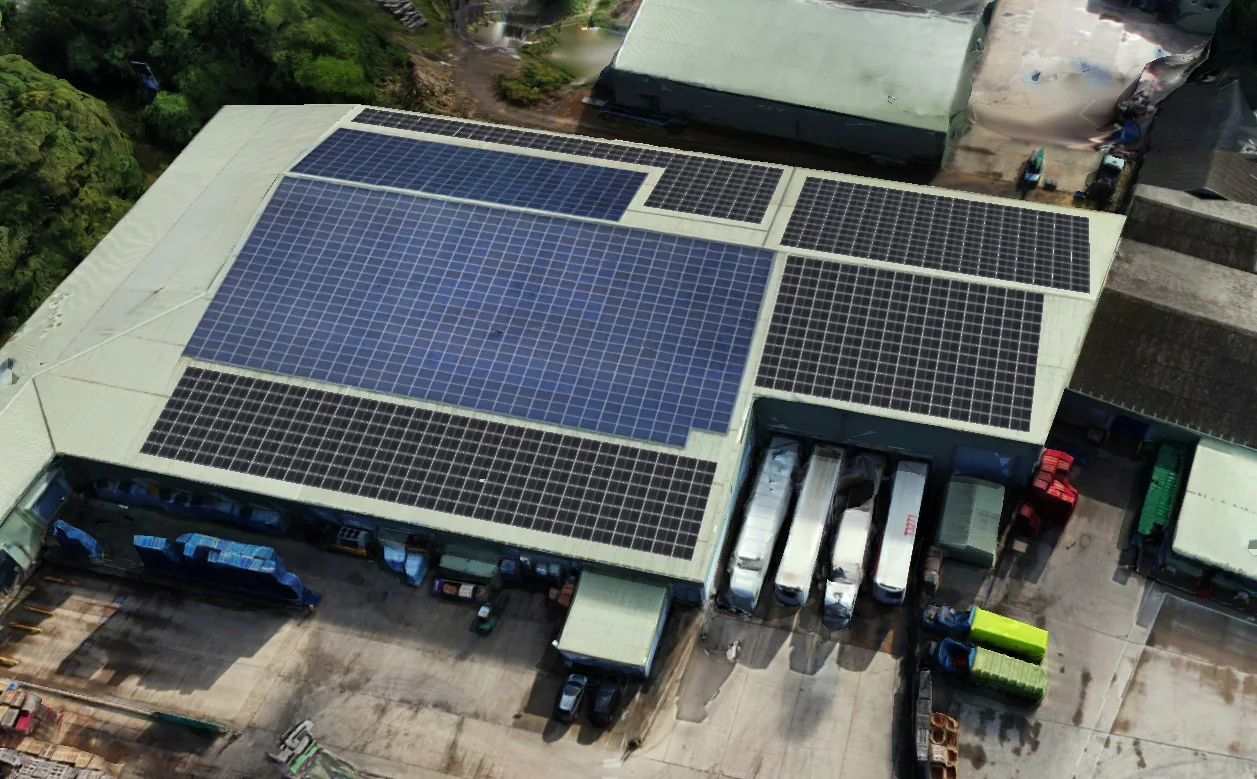
D P Packaging on Northgate in Pinchbeck has been a client since 2014, when we installed a 230 kW solar system on their site. We're now extending it with a further 352.97 kWp array, due to be installed at the beginning of 2027. That will take the combined site to around 583 kWp.
Our design forecasts for the new array alone are about 344,769 kWh a year, with around 62% expected to be used on site and the rest exported. Those are forecasts, not measured results. The point is that the extension was sized around how much power the factory actually uses, not just the roof area. You can see the 3D design model on our commercial solar PV page.
Speak to your accountant
This article is general information, not tax or financial advice. VAT recovery, capital allowances and business rates all depend on your business's own circumstances and can change with each Budget. Please check with your accountant or tax adviser before relying on any of it. What we can do is design the system, give you a clear, itemised quote and provide the paperwork they'll ask for.
Frequently asked questions
Do businesses pay VAT on solar panels? Yes. Installations on business premises are charged at 20%. If you're VAT-registered you can usually reclaim it. The 0% rate only applies to homes and qualifying charity buildings, until 31 March 2027.
Will solar panels increase my business rates? In England, rooftop solar and battery storage used mainly to power your own premises are exempt from business rates until 31 March 2035.
Can I claim solar panels against tax? Usually, yes. Most businesses can use the Annual Investment Allowance (up to £1 million a year) to deduct the cost from profits. Companies can also look at the 50% first-year allowance, because solar panels count as special rate expenditure.
Can a business get paid for exporting solar power? Yes. The Smart Export Guarantee covers solar installations up to 5MW. You need a half-hourly export meter, and rates are set by each supplier, so shop around.
Are there grants for farm solar panels in 2026? At the time of writing, no. The Improving Farm Productivity grant that funded farm rooftop solar is closed, and the FETF 2026 productivity items didn't include rooftop solar PV or batteries.
Is it worth adding a battery to commercial solar? It depends on how much you'd otherwise export and when you use power. We model it from your usage data before recommending one.
Talk to us about your site
If you run a farm, packhouse, cold store or business anywhere around Spalding and South Holland, we'll look at your roof, your supply and your usage, then give you an honest view of what solar and storage could do for you.
Call 07714 736921, email info@ppmelectricalspalding.co.uk or get in touch here. You can also read more about our commercial solar PV work, farm and agricultural solar, our commercial electrician services, and our earlier piece on commercial solar in Spalding and Lincolnshire.